Breakthrough quantum-secure link protects data using the laws of physics
Australian technology has delivered a live quantum-secure link, a breakthrough that promises to future-proof critical data against tomorrow’s cyber threats.
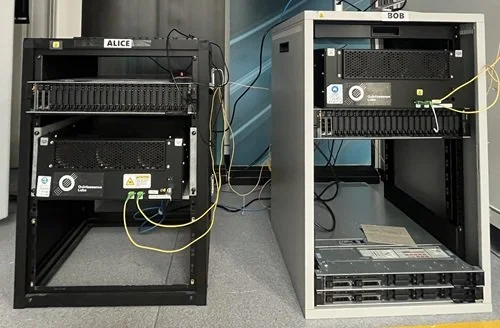
The project brings together QuintessenceLabs, Australia’s national science agency CSIRO, and AARNet, the national research and education network. By combining local expertise in quantum cyber security, digital science and advanced fibre infrastructure, the partners have successfully demonstrated a quantum key distribution (QKD) system running over standard optical fibre.
Together, these organisations are building sovereign quantum capability to protect Australia’s most valuable data.
Today’s digital world runs on long-lived data: health records, financial transactions, research findings and personal files stored in the cloud. Criminals can already copy encrypted data and wait, hoping future computers will eventually break today’s codes.
QKD stops that long-game by generating unbreakable encryption keys rooted in the laws of physics. Put simply, it uses tiny signals of light to create secret codes between two points; if anyone tries to listen in, the system takes protective action.
When deployed more widely, QKD could provide a new layer of tamper-evident security across optical fibre, complementing existing cyber-defence tools.
Using a new AARNet fibre loop at CSIRO’s Marsfield site in Sydney, QuintessenceLabs deployed its qOptica continuous variable QKD system, or CV-QKD.
Although the current system supports experiments and research, at 12.7 kilometres long the link produced strong secret key rates despite real-world fibre losses, demonstrating its readiness for practical use. The team’s next step is to extend the live link to longer distances to hopefully cover cities, states and partnering countries.
Vikram Sharma, Founder and CEO of QuintessenceLabs explains how this deployment showcases the strength of Australian collaboration in advancing quantum cybersecurity.
“Integrating CSIRO’s research expertise, AARNet’s network infrastructure, and QuintessenceLabs’ quantum technology, we have demonstrated that quantum-secure communications are practical on today’s networks,” Mr Sharma said.
“It’s a vital step toward protecting Australia’s most critical data and strengthening resilience against emerging threats.”
CSIRO quantum cryptography research scientist Dr Sebastian Kish said the unique feature of QKD is that it makes fibre connections like the NBN inherently secure.
“If someone tries to tap the line, the quantum signals change and the alarms go off. It’s like giving Australia’s everyday internet an in-built security alarm, powered by the laws of physics,” Dr Kish said.
Dr Seyit Camtepe, CSIRO cyber and quantum security research scientist, explains this was a proud first step.
“Our ambition was to enable the nation to develop and test future-proof cybersecurity innovations using the laws of physics – and we’ve achieved an important milestone,” Dr Camtepe said.
Chief Technology Officer for AARNet David Wilde said this marks the first publicly documented deployment of quantum key distribution over telecom-grade dark fibre in Sydney, and among the first in Australia.
“Demonstrations like this show how Australia’s research network can lead the way in trialling quantum-secure communications, building the foundations for protecting critical research and education data across our wider national infrastructure,” Mr Wilde said.
Next, the partners will expand the link across a longer AARNet fibre route and test it under real-world conditions.
They will also explore an inter-city route between Canberra and Sydney and pilot integrations with VPNs and cloud key-management. Together, these efforts mark a major step toward embedding quantum-secure infrastructure across essential services and building a resilient, sovereign cyber capability.
The team is inviting enquiries from researchers, government agencies and industry to expand this technology further in Australia.
This media release was first published by AARNet.
Other News