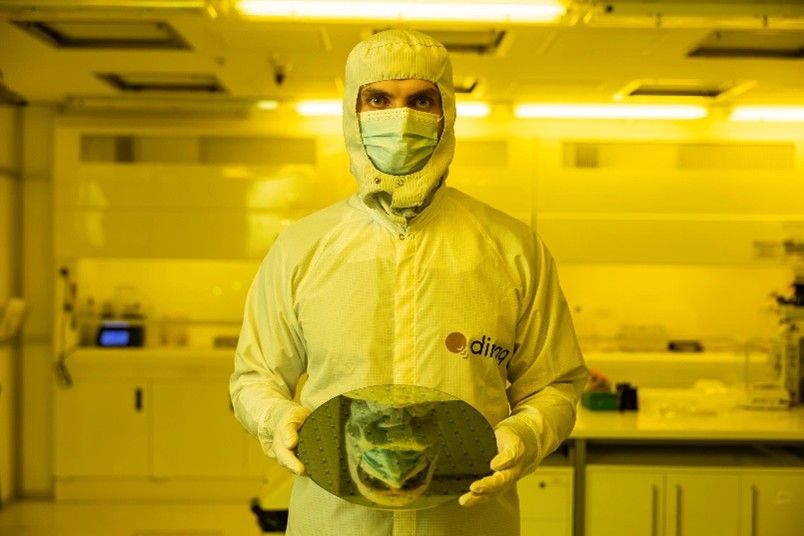
Diraq and Silicon Quantum Computing (SQC), have been selected by the U.S. Defense Advanced Research Projects Agency (DARPA) to advance to Stage B of its Quantum Benchmarking Initiative (QBI).
DARPA has selected eleven companies to enter the second stage (Stage B) of the agency’s Quantum Benchmarking Initiative (QBI), which aims to rigorously verify and validate whether any quantum computing approach can achieve utility-scale operation — meaning its computational value exceeds its cost — by the year 2033.
As QBI continues, DARPA anticipates additional teams to advance to stages A, B, and C, as described below. Companies have entered the evaluation process on varying timelines, resulting in staggered advancement across the three stages.
During the six-month Stage A, companies characterized their unique concepts for creating a useful, fault-tolerant quantum computer. Now, in the yearlong Stage B, they will develop and detail their R&D plans, including identifying and mitigating the associated risks, and specifying the necessary risk-reduction prototypes. Companies successful in Stage B will be invited to progress to QBI’s final stage, in which a government verification and validation team will determine if their utility-scale quantum computer concept can be constructed as designed and operated as intended.
Companies selected for Stage B have described compelling technical concepts and the QBI team will scour their R&D plans to determine whether they are on track to meet not only near-term milestones, but also the ultimate objective: a useful quantum computer by 2033.
A significant challenge in evaluating quantum computing development plans lies in the diversity of technological approaches. Unlike classical computing, no single dominant architecture exists. The Stage B teams employ a wide range of quantum bit (qubit) technologies – the fundamental building blocks of a quantum computer – each with its own strengths, weaknesses, and technical hurdles.
QBI is not a competition to narrow the field to a few “winners.” Rather, the aim is to evaluate each company’s approach on its own merits. Multiple, single, or even no participants will ultimately demonstrate a path to an industrially useful quantum computer within the next eight years. Thorough evaluation is crucial to understanding the true potential of the technology.
The following companies (with their qubit technology approach) have been selected for Stage B at this time:
Atom Computing: Boulder, Colorado (scalable arrays of neutral atoms)
Diraq: Sydney, Australia, with operations in Palo Alto, California, and Boston, Massachusetts (silicon CMOS spin qubits)
IBM: Yorktown Heights, New York (quantum computing with modular superconducting processors)
IonQ: College Park, Maryland (trapped-ion quantum computing)
Nord Quantique: Sherbrooke, Quebec, Canada (superconducting qubits with bosonic error correction)
Photonic Inc.: Vancouver, British Columbia, Canada (optically-linked silicon spin qubits)
Quantinuum: Broomfield, Colorado (trapped-ion quantum charged coupled device (QCCD) architecture)
Quantum Motion: London, UK (MOS-based silicon spin qubits)
QuEra Computing: Boston, Massachusetts (neutral atom qubits)
Silicon Quantum Computing Pty. Ltd.: Sydney, Australia (precision atom qubits in silicon)
Xanadu: Toronto, Canada (photonic quantum computing)
It is likely but not guaranteed that additional teams will enter Stage B in the future. DARPA will announce any additional promotion decisions after contracting with those teams is finalized.
Other News