QuantX Labs delivers quantum clocks for precision timing
QuantX Labs was founded in 2016 by Professor Andre Luiten and Dr Martin O’Connor as a spinout from the University of Adelaide. The company has since established itself as a national leader in quantum-enabled precision timing.
The business addresses the current dependence on Global Positioning Systems (GPS) and Global Navigation Satellite Systems (GNSS), which creates critical vulnerabilities for defence, space and vital infrastructure sectors.
According to QuantX Labs, resilient and sovereign alternatives for position, navigation and timing (PNT) are essential for maintaining secure operations in contested or degraded environments.
QuantX Labs’ TEMPO, a compact optical atomic clock, delivers up to 10x performance improvement over current GNSS-based systems, allowing for an expansion into space infrastructure.
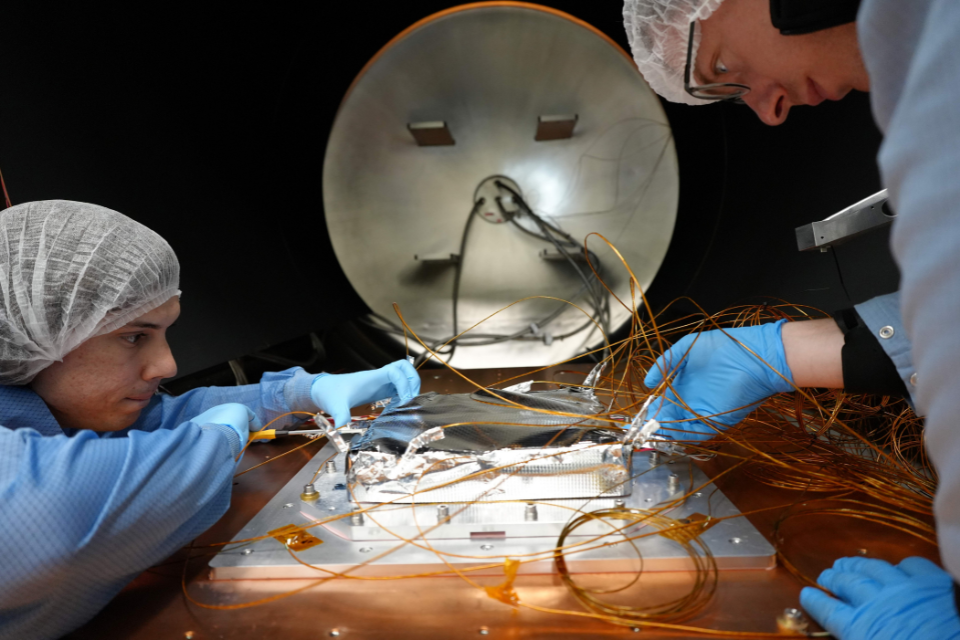
A component of the TEMPO technology is now set to launch on a SpaceX mission, with French space mobility company Exotrail, in early 2026.
Elsewhere, its Cryoclock product, for example, is the world’s purest microwave and radio frequency signal generator, offering ultra-low phase noise and exceptional frequency stability.
Cryoclock has been recognised as providing a critical national capability for secure communications and radar systems, and has been selected for Australia’s A$1.2 billion AIR2025 JORN Phase 6 defence upgrade.
With a team of around 40 people based in the Lot Fourteen innovation precinct in Adelaide, South Australia, QuantX Labs is continuing to innovate.
Currently in development, its new SYNCHRO product is a time-transfer system using classical signals, with a quantum variant further down the pipeline, transmitted over fibre and free-space links.
Another product in development, SENTIO, is an extremely sensitive quantum magnetometer, capable of detecting objects underwater and underground.
Having identified the defence sector as a primary funder and adopter of early deployment of sovereign timing systems, QuantX Labs has been able to advance globally competitive quantum PNT solutions in alignment with Australia’s strategic priorities.
QuantX Labs has been supported by the University of Adelaide’s quantum R&D and technology transfer ecosystems. Its base in Lot Fourteen offers access to commercialisation opportunities and talent pipelines.
The business has also been funded by the Australian Department of Defence, including the Defence, Science and Technology Group and AIR2025 programs.
This local support has led to global recognition. This includes the partnership with Exotrail, and a mandate to deliver a defence-funded mobile timing testbed to the Defence Science and Technology Group in Edinburgh in 2025.
In September 2025, QuantX Labs will travel to the Quantum World Congress in Washington DC, as part of the Austrade delegation.
Other News