South Australian-developed quantum clocks successfully trialled in Washington D.C

Four South Australian-developed world-leading quantum clocks have been successfully trialled in the United States, as part of Australia’s investment in AUKUS Pillar II, as another South Australian company signs a new strategic contract with a major UK defence contractor.
The six-week trial in Washington D.C. involved Adelaide-based QuantX Labs and the University of Adelaide, who each contributed two clocks for testing by AUKUS partners to evaluate their performance against a range of environmental conditions and identify their potential for defence applications.
Quantum optical atomic clocks are used in the synchronisation of communications networks, and can detect GPS signal jamming or spoofing, and provide reliable position, navigation, and timing information.
Under the AUKUS Pillar II, Australia, the United States and the United Kingdom are accelerating the development of quantum technology, with South Australia playing a key role.
Federal Defence Industry Minister Pat Conroy said Australia was at the “forefront” of quantum technology.
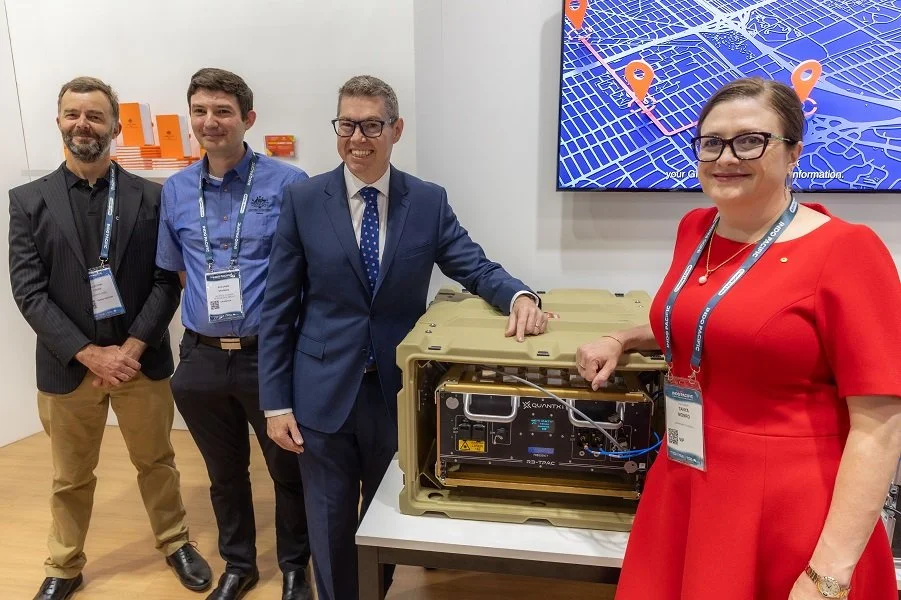
A quantum clock developed by SA-based QuantX Labs at the Indo Pacific International Maritime Exposition in Sydney on Tuesday. The clock has just finished trials with Australia’s AUKUS partners in Washington D.C. Picture: Supplied
“This collaboration harnesses expertise and experience from AUKUS partners and leverages emerging technologies to deliver the capabilities our militaries need,” Mr Conroy said.
“Through AUKUS Pillar II, we are achieving capability development faster than any one of our nations could achieve alone.”
The government says integrating quantum clock technology into the militaries within the AUKUS partnership would enhance the Australian Defence Force’s ability to operate in environments where GPS navigation is unavailable or unreliable.
The development of the clocks was funded through $2.7 million in federal government contracts, in conjunction with the Defence Science and Technology Group and industry and academic partners.
The outcomes of the quantum clock trials will inform analysis of how the technology may be used in future defence operations.
The clocks are the result of more than seven years of research, that began at the Institute of Photonics and Advanced Sensing at The University of Adelaide.
Quantum technology was identified in the government’s 2024 National Defence Strategy as playing a “vital role” in the future of the ADF, and is expected to boost productivity and enhance performance of other emerging technologies, including AI and robotics.
Other News