QSI Seminar: Stefano Pirandola, , nodeQ and UY (UK)
Opportunities, limitations and trade-offs in future quantum communication networks
QSI Seminar Yuval Sanders, Centre for Quantum Software and Information, AUS
A growing methodological problem for practical quantum algorithms research TITLE: Why are quantum algorithms papers so #!@*&% long? SPEAKER: Dr Yuval Sanders AFFILIATION: Centre for Quantum Software and Information, University of Technology Sydney ABSTRACT: In this talk I discuss the results of two of my recent quantum algorithms papers: arXiv:2007
QSI Seminar: Elija Perrier, UTS Centre for Quantum Software and Information, AUS
Ethical quantum computing: A Roadmap TITLE: Quantum Ethics SPEAKER: Elija Perrier https://hmi
QSI Seminar: Kamil Korzekwa, Jagiellonian University, Poland
The fundamental constraints on population dynamics generated by Markovian thermal processes
QSI Seminar: Kunal Sharma, University of Maryland, USA
Expressibility and trainability of parameterized quantum circuits for variational quantum algorithms and quantum neural networks
QSI Seminar: Sukin Sim, Zapata Computing, Boston, USA
How to improve the relative performance of variational algorithms, with strategies for initializing and optimizing larger parameterized quantum circuits
QSI Seminar: Zixin Huang, Macquarie University, Sydney
Detecting stars and exoplanets with quantum imaging and light detection and ranging (LIDAR) remote sensing to overcome the Rayleigh criterion
QSI Seminar: Zhicheng Zhang, UCAS, Beijing
The power of parallelism to speed up quantum simulation TITLE: Parallel Quantum Algorithm for Hamiltonian Simulation TOPIC: Quantum Algorithms SPEAKER: Zhicheng Zhang AFFILIATION: University of Chinese Academy of Sciences, Beijing, China ABSTRACT: We study how parallelism can speed up quantum simulation
QSI Seminar: Mauro E.S. Morales, UTS Centre for Quantum Software & Information, Australia
When initialised with suitable input states, fermionic linear optics circuits can be used to demonstrate quantum computational advantage with strong hardness guarantees
QSI Seminar: Yihui Quek, Stanford University, California
Demonstrating the flexibility and precision of quantum singular value transform (QSVT) to implement tools in quantum linear algebra, quantum noise recovery and optimal quantum measurements
QSI Seminar: Ryan Mann, University of Bristol, UK
A simple and concise exposition of widely accessible techniques to construct classical algorithms
QSI Seminar: Xin Hong, QSI, University of Technology Sydney
A Tensor Decision Diagrams (TDD) is a new decision-diagram style data structure that provides a compact and canonical representation of quantum functionalities for the automated design of quantum circuits
Building a strong quantum industry in Sydney, Visiting Entrepreneur Program, 8 June 2021
Hear from a panel of experienced researchers and entrepreneurs as they debate, discuss, and plan Sydney's present and future quantum industry
QSI Seminar: Anurag Anshu, UC Berkeley, USA
Proving that the entanglement entropy in the ground state of a locally gapped frustration-free 2D lattice spin system satisfies an area law
QSI Seminar: Martin Plávala, University of Siegen, Germany
TITLE: Jordan products of quantum channels and their compatibility: Examining the task of determining whether two quantum channels are compatible TOPIC: Foundations/Quantum information theory SPEAKER: Dr Martin Plávala (in collaboration with Mark Girard and Jamie Sikora) AFFILIATION: Theoretical Quantum Optics Group, University of Siegen, Germany ABSTRACT: Given two quantum channels, we examine the task of determining whether they are compatible - meaning that one can perform both channels simultaneously but, in the future, choose exactly one channel whose output is desired (while forfeiting the output of the other channel)
QSI Seminar: Richard Kueng, Johannes Kepler University Linz, Austria
An efficient method for constructing an approximate classical description of a quantum state using very few measurements of the state
QSI Seminar: Pedro Costa, Macquarie University, Sydney
Quantum cellular automaton, an abstract model used to validate the quantum-to-classical transition
AQIS '20: Patrick Coles, Promises and Challenges of Variational Quantum Algorithms
SPEAKER: Adjunct Assistant Professor Patrick Coles AFFILIATION: Los Alamos National Laboratory (LANL), USA TITLE: Promises and Challenges of Variational Quantum Algorithms SESSION CHAIR: Dr
AQIS '20: Francesco Buscemi. Statistical tests of 'quantumness': From mathematics to technology
SPEAKER: Professor Francesco Buscemi AFFILIATION: Nagoya University, Japan TITLE: Statistical tests of 'quantumness': From mathematics to technology SESSION CHAIR: Professor Keisuke Fujii, Division of Advanced Electronics and Optical Science, Osaka University, Japan ABSTRACT: With the ever increasing expectations surrounding quantum technologies, a basic question common to a variety of areas within quantum information science is to characterize the divide between classical (i
AQIS '20: Qiang Zhang, Recent experimental progress in quantum key distribution.
SPEAKER: Professor Qiang Zhang AFFILIATION: University of Science and Technology of China (USTC), China TITLE: Recent experimental progress in quantum key distribution SESSION CHAIR: Professor Francesco Buscemi, Nagoya University, Japan ABSTRACT: Quantum key distribution (QKD) together with one time pad encoding can provide unconditional secure communication
AQIS '20: François Le Gall, Average-Case Quantum Advantage with Shallow Circuits
SPEAKER: Associate Professor François Le Gall AFFILIATION: Nagoya University, Japan TITLE: Average-Case Quantum Advantage with Shallow Circuits SESSION CHAIR: Dr
AQIS '20: Takashi Yamamoto, Quantum network with atoms and photons
SPEAKER: Professor Takashi Yamamoto AFFILIATION: Osaka University, Japan TITLE: Quantum network with atoms and photons SESSION CHAIR: Professor Keisuke Fujii, Osaka University, Japan ABSTRACT: I will discuss several experiments on elemental schemes for a quantum network with atoms and photons in this talk
AQIS '20: Zhengfeng Ji, Spooky complexity at a distance
SPEAKER: Professor Zhengfeng Ji AFFILIATION: Centre for Quantum Software and Information, University of Technology Sydney, Australia TITLE: Spooky complexity at a distance SESSION CHAIR: Professor Michael Bremner, University of Technology Sydney, Australia ABSTRACT: In this talk, I will discuss the recent result on the characterisation of the power of quantum multi-prover interactive proof systems, MIP*=RE (arXiv:2001
AQIS '20: Andrew Dzurak, Silicon-based quantum computing.
SPEAKER: Scientia Professor Andrew Dzurak AFFILIATION: UNSW Sydney, Australia TITLE: Silicon-based quantum computing: The path from the laboratory to industrial manufacture SESSION CHAIR: Professor Stephen Bartlett, University of Sydney, Australia ABSTRACT: In this talk I will give an overview of the development of silicon-based quantum computing (QC), from the basic science through to its prospects for industrial-scale commercialization based on CMOS manufacturing
AQIS '20 Opening Remarks
- Associate Professor Min-Hsiu Hsieh, Centre for Quantum Software and Information, University of Technology Sydney - Professor Zhengfeng Ji, Centre for Quantum Software and Information, University of Technology Sydney - Professor Stephen Bartlett, Centre for Engineered Quantum Systems, University of Sydney
AQIS '20: Da-Wei Wang, Topological phases of quantized light
SPEAKER: Professor Da-Wei Wang AFFILIATION: Zhejiang University, China TITLE: Topological phases of quantized light SESSION CHAIR: Dr
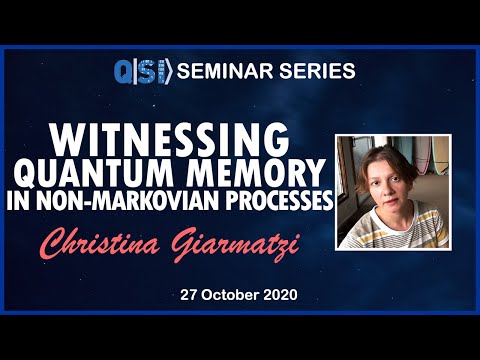
QSI Seminar: Dr Christina Giarmatzi, UTS QSI, Witnessing quantum memory in non-Markovian processes
A method to detect quantum memory in a non-Markovian process TITLE: Witnessing quantum memory in non-Markovian processes SPEAKER: Dr Christina Giarmatzi AFFILIATION: Centre for Quantum Software and Information, University of Technology Sydney HOSTED BY: Dr Clara Javaherian, UTS Centre for Quantum Software and Information ABSTRACT: We present a method to detect quantum memory in a non-Markovian process
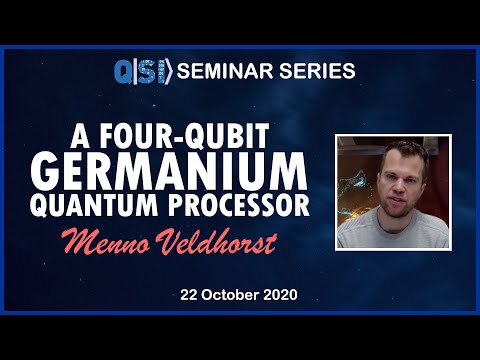
QSI Seminar: Dr Menno Veldhorst, QuTech | Kavli Institute of Nanoscience, Delft U, 22/10/2020
Germanium was taken over by silicon in the development of classical technology, but now strikes back in the era of quantum technology
QSI Seminar: Prof Benjamin Huard, ENS de Lyon, Measuring the number of photons in a microwave mode
Improving photon number measurements using multiplexing or quantum memory
QSI Seminar: Kaumudibikash Goswami, UQ, Indefinite causal order
Achieving a communication advantage with an experimental realisation of an indefinitely causal ordered scenario
QSI Seminar: Dr Viv Kendon, Durham University, Quantum Computing using Continuous-Time Evolution
Strategies for quantum optimisation algorithms with short run-times
QSI Seminar: A/Prof Eric Chitambar, UIUC, Building Multiple Access Channels with a Single Particle
A multiple access channel where the communication medium consists of just a single classical or quantum particle TITLE: Building Multiple Access Channels with a Single Particle SPEAKER: Associate Professor Eric Chitambar AFFILIATION: University of Illinois at Urbana-Champaign, Illinois, USA HOSTED BY: Associate Professor Min-Hsiu Hsieh, UTS Centre for Quantum Software and Information ABSTRACT: A multiple access channel describes a situation in which multiple senders are trying to forward messages to a single receiver using some communication medium
QSI Seminar: Dominik Hangleiter, FU Berlin, Classical vs Quantum Learning of Discrete Distrib'ns
Quantum versus classical learnability of discrete distributions
QSI Seminar: Dr Vincent Mourik, FQT | CQC2T, UNSW Sydney, 15/09/2020
A 60-year old mechanism enabling nuclear resonance using purely electric fields resurfaces enabling coherent quantum control of single nuclear spin
QSI Seminar: Dr Sahand Mahmoodian, ITP, Leibniz U., Quantum Many-Body Physics of Photons, 03/09/2020
A conceptually simple platform for exploring quantum many-body states of photons TITLE: Quantum many-body physics of photons in waveguide QED SPEAKER: Dr Sahand Mahmoodian AFFILIATION: Institute for Theoretical Physics, Institute for Gravitational Physics (Albert Einstein Institute), Leibniz University, Hannover, Germany HOSTED BY: A/Prof Nathan Langford, UTS Centre for Quantum Software and Information ABSTRACT: The generation and control of strongly interacting photons is a long-standing goal of quantum optics
QSI Seminar: Dr Sarah Kaiser, Independent Researcher/Consultant, WA, USA, Introduction to Q#, 08/09
Q# and the Quantum Development Kit: Research and program quantum algorithms in the way you think about them
QSI Seminar: Dr Peter Johnson, Zapata Computing, Minimising Estimation Runtime on Noisy Q.Computers.
An estimation algorithm, incorporating noise models into its design and optimizing for minimal runtime
QSI Seminar: Prof Dieter Suter, TU Dortmund University, DEU, Hybrid Quantum Registers, 21/08/2020
Efficient control and protection against environmental noise TITLE: Hybrid Quantum Registers: Efficient control and protection against environmental noise SPEAKER: Professor Dieter Suter AFFILIATION: TU Dortmund University, Germany HOSTED BY: Dr Clara Javaherian, UTS Centre for Quantum Software and Information ABSTRACT: Nuclear and electronic spins are attractive objects not only for spectroscopic studies, but also for emergent technologies like quantum information processing and sensing
QSI Seminar: Prof Jason Twamley, OIST JPN | MQ AUST, Quantum Machines, 04/08/2020
A review of various types of quantum machines TITLE: Quantum Machines SPEAKER: Professor Jason Twamley AFFILIATION: Unit for Quantum Machines, Okinawa Institute of Science and Technology Graduate University, Japan | Macquarie University Research Centre in Quantum Science and Technology, Sydney HOSTED BY: Dr Clara Javaherian, UTS Centre for Quantum Software and Information ABSTRACT: A quantum machine is a device that makes use of different interconnected physical quantum subsystems to provide an overall functionality not possible in any subsystem alone
QSI Seminar: Dr Olivia Di Matteo, TRIUMF, Reading Between the Bitlines, 07/08/2020
The current state of quantum RAM TITLE: Reading between the bitlines: the current state of quantum RAM SPEAKER: Dr Olivia Di Matteo AFFILIATION: TRIUMF, Vancouver, Canada HOSTED BY: Dr Márika Kieferová, UTS Centre for Quantum Software and Information ABSTRACT: Quantum RAM, or qRAM, is a controversial topic in quantum computing
QSI Seminar: Dr Markus Heyl, Max Planck Inst., Reinforcement Learning for Digital Quantum Simulation
Machine learning quantum circuits for digital quantum simulation TITLE: Reinforcement Learning for Digital Simulation SPEAKER: Dr Markus Heyl AFFILIATION: Max Planck Institute of Quantum Optics, Dresden HOSTED BY: A/Prof Nathan Langford, UTS Centre for Quantum Software and Information ABSTRACT: Digital quantum simulation is a promising application for quantum computers
QSI Seminar: Dr Audrey Bienfait, ENS Lyon | U.Chicago, Phonon-mediated quantum state transfer, 28/07
TITLE: Phonon-mediated quantum state transfer, remote entanglement and quantum erasure SPEAKER: Dr Audrey Bienfait AFFILIATION: École Normale Supérieure de Lyon, France | University of Chicago, USA HOSTED BY: A/Prof Nathan Langford, UTS Centre for Quantum Software and Information ABSTRACT: Heavily used in classical signal processing, surface acoustic waves (SAWs) have also been proposed as a means to coherently couple distant solid-state quantum systems
QSI Seminar: Dr Adrian Chapman, USyd, Characterization of free-fermion-solvable spin models 07/07/20
Free-Fermion Solutions and Frustration Graphs TITLE: Characterization of free-fermion-solvable spin models via graph invariants SPEAKER: Dr Adrian Chapman AFFILIATION: ARC Centre of Excellence for Engineered Quantum Systems (EQUS), University of Sydney, Australia HOSTED BY: A/Prof Chris Ferrie, UTS Centre for Quantum Software and Information ABSTRACT: Finding exact solutions to spin models is a fundamental problem of many-body physics
QSI Seminar: Pantita Palittapongarnpim, Chulalongkorn U., ML for Adaptive Phase Estimation, 10/07/20
How a known framework in control engineering, namely data-driven control can be formulated for quantum control
QSI Seminar: Prof. Rodney Van Meter, Keio University, Engineering the Quantum Internet, 30/06/2020
'RuleSet-based Quantum Internet' architecture and the simulation tools for working protocols TITLE: Engineering the Quantum Internet SPEAKER: Professor Rodney Van Meter AFFILIATION: Keio University Quantum Computing Center, Tokyo, Japan HOSTED BY: Dr Simon Devitt, UTS Centre for Quantum Software and Information ABSTRACT: Experimental progress toward a general-purpose Quantum Internet is advancing rapidly, but the challenges in building a Quantum Internet extend far beyond having a physical layer that can create entanglement across a distance
QSI Seminar: Ramis Movassagh, MIT-IBM Watson AI Lab, Cayley Path and Quantum Supremacy, 03/07/2020
Hardness of Random Circuit Sampling (Google's supremacy experiment) TITLE: Cayley Path and Quantum Supremacy SPEAKER: Dr Ramis Movassagh AFFILIATION: MIT-IBM Watson AI Lab, Cambridge MA, USA HOSTED BY: Prof Michael Bremner, UTS Centre for Quantum Software and Information ABSTRACT: Given the large push by academia and industry (e
QSI Seminar: Lana Mineh, U.Bristol, Solving the Fermi-Hubbard Model on Near-Term Q.Computers 24/06
Finding the ground state of the Hubbard model using hybrid quantum-classical computing
QSI Seminar: Prof Lieven Vandersypen, QuTech, Delft U, 25/06/2020
Silicon spin qubits gain traction for large-scale quantum computation and simulation
QSI Seminar: Guillaume Verdon, X, Quantum-probabilistic Generative Models, 19/06/2020
Building better deep learning representations for quantum mixed states by adding quantum layers to classical probabilistic models
QSI Seminar: A/Prof Robin Blume-Kohout & Dr Erik Nielsen, Sandia, 12/06/2020
A framework for defining and classifying crosstalk errors in quantum processors, and a method for performing approximate density matrix propagation
QSI Seminar: Dr Daniel Grier, U.Waterloo, Quantum Advantage - Interactive Shallow Clifford Circuits
Constant-depth quantum circuits can outperform log-depth classical circuits for certain interactive tasks
QSI Seminar: Dr Marissa Giustina, Google Research, Building Google's Quantum Computer, 09/06/2020
So you want to build a useful quantum computer… where to begin?! TITLE: Building Google’s Quantum Computer SPEAKER: Dr Marissa Giustina AFFILIATION: Google AI Quantum, Google Research, CA, USA HOSTED BY: A/Prof Nathan Langford, UTS Centre for Quantum Software and Information ABSTRACT: The Google AI Quantum team develops chip-based circuitry that one can interact with (control and read out) and which behaves reliably according to a simple quantum model
QSI Seminar: Dr Maria Schuld, Xanadu, Encoding Classical Data into Quantum States for ML, 05/06/2020
This talk sheds light on different aspects of encoding classical data into quantum states for machine learning
QSI Seminar: Asst Prof Nathan Wiebe, PNNL, Training Fully Quantum Boltzmann Machines, 29/05/2020
A physics inspired class of quantum neural network for generative training TITLE: Training Fully Quantum Boltzmann Machines SPEAKER: Affiliate Assistant Professor Nathan Wiebe AFFILIATION: Pacific Northwest National Laboratory | University of Washington, USA HOSTED BY: Dr Márika Kieferová, UTS Centre for Quantum Software and Information ABSTRACT: In recent years quantum machine learning has grown by leaps and bounds but a major problem still vexes the field is how to efficiently train quantum neural networks
QSI Seminar: Dr Kai-Min Chung, A.Sinica, How well can a classical client delegate quantum comput'n?
Cryptographic protocols for classical clients to verifiably delegate quantum computation to untrusted quantum servers - the desiderata and their feasibility
QSI Seminar: Dr Gerardo Paz Silva, Griffith U, Noise Cancellation and your quantum computer 27/05/20
Controls and frames: A new approach to quantum noise spectroscopy TITLE: Noise Cancellation and your Quantum Computer SPEAKER: Dr Gerardo Paz Silva AFFILIATION: Centre for Quantum Dynamics, Griffith University, Brisbane, Qld, Australia HOSTED BY: A/Prof Chris Ferrie, UTS Centre for Quantum Software and Information ABSTRACT: Noise cancellation, as in everyday headphones, requires the ability to characterize & filter out the noise affecting a system one wants to protect
QSI Seminar: A/Prof Chris Ferrie, UTS QSI, Self Guided Quantum Learning, 15/05/2020
Self-Guided Quantum Learning: Estimation via optimisation applied to quantum estimation TITLE: Self-Guided Quantum Learning SPEAKER: Associate Professor Chris Ferrie AFFILIATION: Centre for Quantum Software and Information, University of Technology Sydney, Australia HOSTED BY: Dr Clara Javaherian, UTS Centre for Quantum Software and Information, Australia ABSTRACT: Quantum state learning is often understood as a data analytics problem—large amounts of data collected from many prior repetitions of incompatible measurements need to be churned into a single estimate of a quantum state or channel
QSI Seminar: Asst. Prof. Nana Liu, SJTU, Introducing Adversarial Quantum Learning, 22/05/2020
Protecting and leveraging quantum machine learning algorithms on a future quantum internet TITLE: Introducing Adversarial Quantum Learning: Security and machine learning on the quantum internet SPEAKER: Assistant Professor Nana Liu AFFILIATION: Shanghai Jiao Tong University, PR China HOSTED BY: A/Prof Chris Ferrie, UTS Centre for Quantum Software and Information ABSTRACT: In the classical world, there is a powerful interplay between security and machine learning deployed in a network, like on the modern internet
QSI Seminar: Asst Prof Yvonne Gao, Centre for Quantum Technologies, NUS, Singapore, 12/05/2020
Engineering a coherent and tunable bilinear coupling between two microwave quantum memories in a 3D circuit QED architecture
QSI Seminar: Prof Sergio Boixo, Google Research, LA, Quantum Supremacy, 05/04/2020
This talk explains the quantum supremacy milestone achieved by Google
QSI Seminar: Asst Prof Josh Combes, University of Colorado Boulder, USA, 08/05/2020
Bosonic mode error correcting codes: Quantum oscillators with an infinite Hilbert space TITLE: Quantum computing with rotation-symmetric bosonic codes SPEAKER: Assistant Professor Josh Combes AFFILIATION: University of Colorado Boulder, CO, USA HOSTED BY: A/Prof Chris Ferrie, UTS Centre for Quantum Software and Information ABSTRACT: Bosonic mode error correcting codes are error correcting codes where a qubit (or qudit) is encoded into one or multiple bosonic modes, i
QSI Seminar: Dr Chris Granade, Microsoft, 01/05/2020
Q#, a quantum-focused domain-specific language explicitly designed to correctly, clearly and completely express quantum algorithms
QSI Seminar: Dr Joe Fitzsimons, Horizon Quantum Computing, Abstracting Quantum Computation 28/04/'20
From queues to qubits: Compiling classical code to quantum for quantum processors TITLE: Abstracting Quantum Computation SPEAKER: Dr Joe Fitzsimons AFFILIATION: Horizon Quantum Computing, Singapore HOSTED BY: Prof Michael Bremner, UTS Centre for Quantum Software and Information ABSTRACT: Quantum computers have the potential to drastically outperform conventional computers for a variety of tasks
CQC2T Colloquium/QSI Seminar: Prof Zhengfeng Ji, QSI, Spooky Complexity at a Distance, 26/03/2020
Characterisation of the power of quantum multi-prover interactive proof systems, MIP*=RE
QSI Seminar: Dr Simon Devitt, QSI, Quantum Sneakernet: Backbone to the quantum internet, 20/04/2020
Nothing beats a trunk load of quantum hard drives hurtling down the highway for building a quantum internet
QSI Seminar: Dr Chris Jackson, CQuIC/UTS QSI, A Scalable Fermion Measurement, 06/04/2020
A scalable tomography for fermonic systems
QSI Seminar: Prof Tom Stace, University of Queensland, A New Kind of Qubit, 14/04/2020
Building a bigger Hilbert space for superconducting devices, one Bloch state at a time