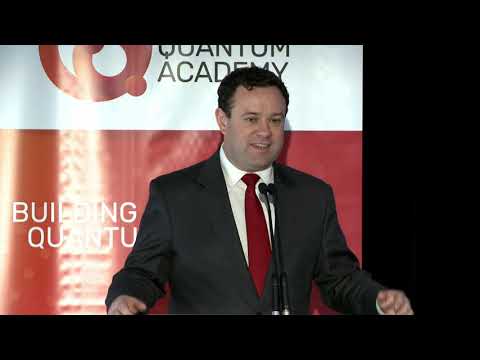
SQA launch recording 7 December 2020
Accelerating the Quantum Ecosystem, introducing the Sydney Quantum Academy
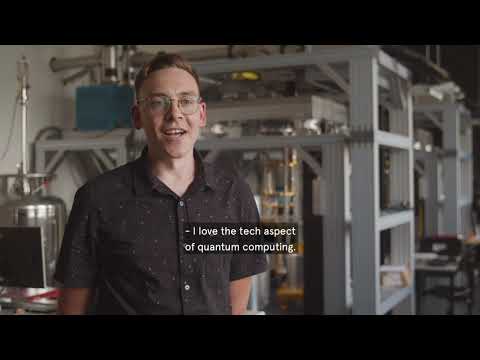
The Sydney quantum community explained by SQA PhD Scholarship students
What excites you about the Sydney quantum scene? Hear from our SQA PhD Scholarship students on what they most get out of being part of the Sydney quantum community
BOULDER OPAL: November 2020 Update
In this video, Dr Michael Hush - Head of Quantum Science & Engineering at Q-CTRL, provides an update on all the exciting new BOULDER OPAL features that have recently been released

How to efficiently characterize quantum computing hardware
In this quantum computing video - part of our Q-CTRL Webinar Series - Dr Michael Hush, Head of Quantum Science & Engineering, and Dr Harry Slatyer, Lead Quantum Product Engineer, will cover the following advanced quantum computing topics: 1) How to use quantum control to characterize unknown system parameters such as Rabi rates, axes of rotation for driven operations, and transmission-line band-limits
QSI Seminar: Dr Christina Giarmatzi, UTS QSI, Witnessing quantum memory in non-Markovian processes
A method to detect quantum memory in a non-Markovian process TITLE: Witnessing quantum memory in non-Markovian processes SPEAKER: Dr Christina Giarmatzi AFFILIATION: Centre for Quantum Software and Information, University of Technology Sydney HOSTED BY: Dr Clara Javaherian, UTS Centre for Quantum Software and Information ABSTRACT: We present a method to detect quantum memory in a non-Markovian process
QSI Seminar: Dr Menno Veldhorst, QuTech | Kavli Institute of Nanoscience, Delft U, 22/10/2020
Germanium was taken over by silicon in the development of classical technology, but now strikes back in the era of quantum technology
BOULDER OPAL: September 2020 Update
This video is the first of many BOULDER OPAL product updates and it is filled with a lot of the features we've been working hard to build over the last several months
QSI Seminar: Kaumudibikash Goswami, UQ, Indefinite causal order
Achieving a communication advantage with an experimental realisation of an indefinitely causal ordered scenario
QSI Seminar: Prof Benjamin Huard, ENS de Lyon, Measuring the number of photons in a microwave mode
Improving photon number measurements using multiplexing or quantum memory
QSI Seminar: A/Prof Eric Chitambar, UIUC, Building Multiple Access Channels with a Single Particle
A multiple access channel where the communication medium consists of just a single classical or quantum particle TITLE: Building Multiple Access Channels with a Single Particle SPEAKER: Associate Professor Eric Chitambar AFFILIATION: University of Illinois at Urbana-Champaign, Illinois, USA HOSTED BY: Associate Professor Min-Hsiu Hsieh, UTS Centre for Quantum Software and Information ABSTRACT: A multiple access channel describes a situation in which multiple senders are trying to forward messages to a single receiver using some communication medium