A framework for defining and classifying crosstalk errors in quantum processors, and a method for performing approximate density matrix propagation.
SEMINAR 1
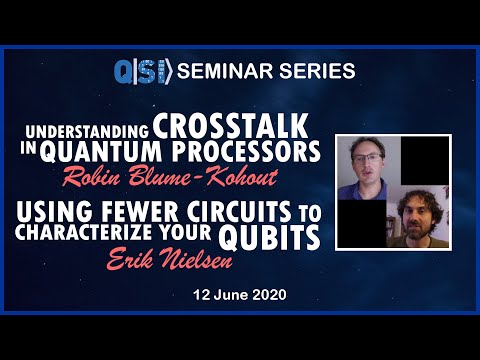
TITLE: Understanding Crosstalk in Quantum Processors
SPEAKER: A/Prof Robin Blume-Kohout
AFFILIATION: Quantum Performance Lab, Sandia National Laboratories, Albuquerque, New Mexico
HOSTED BY: A/Prof Chris Ferrie, UTS Centre for Quantum Software and Information
ABSTRACT:
Multi-qubit quantum processors fail – i.e., deviate from ideal behavior – in many ways. One of the most important, especially as the number of qubits grows, is crosstalk. But “crosstalk” refers to a wide range of distinct phenomena.
In this talk, I will present a precise and rigorous framework that we have developed for defining and classifying crosstalk errors, and compare it to existing ad hoc definitions. Then, I will present two protocols that we are deploying to detect and characterize crosstalk, and show how we are using them to break down and demystify the error behavior of testbed-class quantum processors in the wild.
RELATED ARTICLES:
Detecting crosstalk errors in quantum information processors: https://arxiv.org/abs/1908.09855
SEMINAR 2
TITLE: Hold the onion: using fewer circuits to characterize your qubits
SPEAKER: Dr Erik Nielsen
AFFILIATION: Quantum Performance Lab, Sandia National Laboratories, Albuquerque, New Mexico
HOSTED BY: A/Prof Chris Ferrie, UTS Centre for Quantum Software and Information
ABSTRACT:
Model-based quantum tomography protocols like gate set tomography optimize a noise model with some number of parameters in order to fit experimental data. As the number of qubits increases, two issues emerge: 1) the number of model parameters grows, and 2) the cost of propagating quantum states (density matrices) increases exponentially. The first issue can be addressed by considering reduced models that limit errors to being low-weight and geometrically local.
In this talk, we focus on the second issue and present a method for performing approximate density matrix propagation based on perturbative expansions of error generators. The method is tailored to the likelihood optimization problem faced by model-based tomography protocols. We will discuss the advantages and drawbacks of using this method when characterizing the errors in up to 8-qubit systems.
RELATED ARTICLES:
Probing quantum processor performance with pyGSTi: https://arxiv.org/abs/2002.12476
RESOURCES:
How to install pyGSTi: https://github.com/pyGSTio/pyGSTi/blob/master/jupyter_notebooks/Tutorials/algorithms/ModelTesting.ipynb
OTHER LINKS:
Sandia National Laboratories: https://www.sandia.gov/
Sandia Quantum Performance Laboratory: https://qpl.sandia.gov/
UTS Centre for Quantum Software and Information: https://www.uts.edu.au/research-and-teaching/our-research/centre-quantum-software-and-information
Chris Ferrie: https://www.uts.edu.au/staff/christopher.ferrie