Strategies for quantum optimisation algorithms with short run-times.
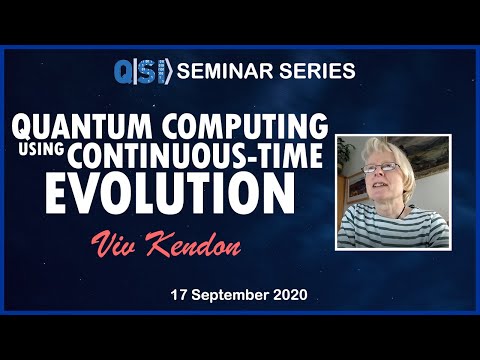
TITLE: Quantum computing using continuous-time evolution
SPEAKER: Dr Viv Kendon
AFFILIATION: Durham University, Durham, UK
HOSTED BY: Dr Peter Rohde, UTS Centre for Quantum Software and Information
ABSTRACT:
Continuous-time quantum computing includes computation by continuous-time quantum walk (QW), adiabatic quantum computing (AQC), quantum annealing (QA), and special purpose quantum simulators.
All evolve the initial quantum state to the final quantum state using a continuous-time process. This is a natural way to compute with quantum systems.
In the setting of the quantum search algorithm, interpolating between AQC and QW computation provides a family of continuous-time quantum algorithms, and also shows that QW is optimal under ideal conditions for large systems.
The structure of correlations can be exploited by choosing the encoding to match, providing further advantages for more realistic problems, such as spin-glasses.
Many repeats of short QW runs is effective for solving hard problems such as spin-glasses and MAX2SAT, providing a more practical approach than AQC in hardware with limited coherence times.
Hybrid strategies combining time-dependent controls with QW-like short timescales can significantly improve success rates over pure QW and we have recently developed tools to guide algorithm development in this setting.
RELATED PAPERS
J. G. Morley, N. Chancellor, S. Bose, and V. Kendon.
Quantum search with hybrid adiabatic-quantum walk algorithms and realistic noise, PRA, 99:022339, 2019. arXiv:1709.00371
https://arxiv.org/abs/1709.00371
A. Callison, N. Chancellor, F. Mintert, and V. Kendon.
Finding spin-glass ground states using quantum walks
NJP, 21:123022, 2019. arXiv:1903.05003
https://arxiv.org/abs/1903.05003
Adam Callison, Max Festenstein, Jie Chen, Laurentiu Nita, Viv Kendon, Nicholas Chancellor.
An energetic perspective on rapid quenches in quantum annealing
arXiv:2007.11599
https://arxiv.org/abs/2007.11599
OTHER LINKS
Quantum Light and Matter (QLM) research, Durham University
https://www.dur.ac.uk/qlm/
Dr Peter Rohde: https://www.uts.edu.au/staff/peter.rohde
UTS Centre for Quantum Software and Information: https://www.uts.edu.au/research-and-teaching/our-research/centre-quantum-software-and-information