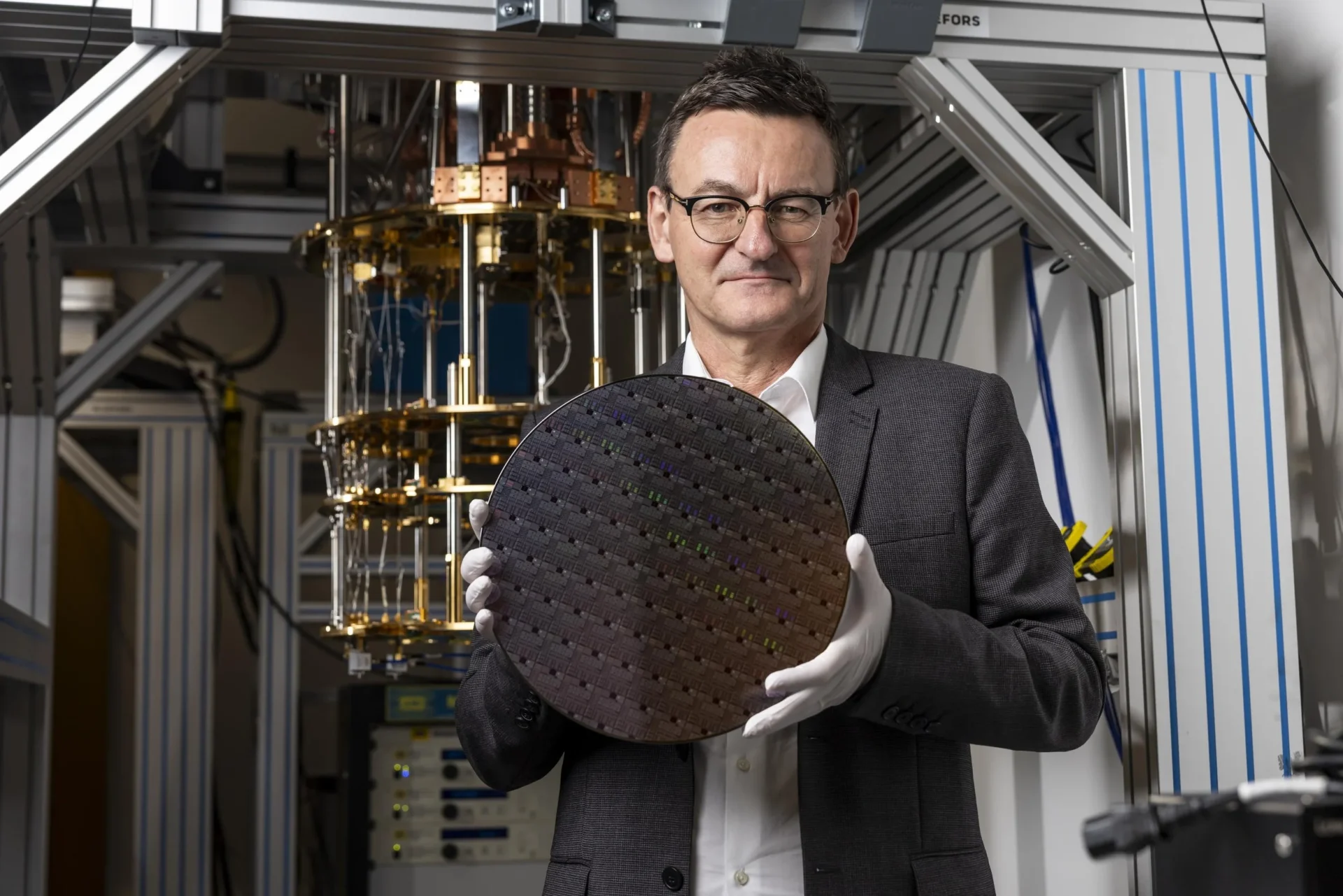
Diraq Integrates NVIDIA NVQLink to Accelerate Hybrid Quantum–Classical Computing
One of the key advantages of silicon spin qubits is their speed: Diraq’s utility-scale machines will be capable of performing a million fault-tolerant operations in less than a minute. But this means that Diraq needs a low-latency link — one that can connect the classical electronics required to control qubits, and the high-performance computers needed to correct errors, and to facilitate hybrid classical–quantum applications. NVIDIA has solved the problem by delivering NVIDIA NVQLink.
Diraq’s engineers are no strangers to the power of NVIDIA’s interfacing technology. Back in June, Diraq shared preliminary ways in which the team was using NVIDIA DGX Quantum for initialization, calibration and readout of its qubits. NVQLink supersedes DGX Quantum, providing an open platform with which Diraq will be able to orchestrate multiple aspects of its quantum processing unit (QPU), and the hardware required to control it.
Speaking at the NVIDIA AI Day in Sydney earlier this month, Diraq’s Head of Theory, Andre Saraiva, outlined the myriad ways that having a low-latency link is crucial for Diraq’s system. Saraiva sees NVQLink as a holistic platform that will address many computing needs simultaneously.
He also stressed another key advantage of working with NVQLink: “This platform unlocks opportunities to work with other teams, because NVIDIA systems are so powerful and so widespread. People get excited about having an interface that they are familiar with, and that they can use to try out new ideas. As instruments for collaboration in quantum computing, NVIDIA tools are second to none.”
One such collaboration involves Diraq’s work with the Quantum Performance Lab at Sandia National Labs. Diraq’s engineers will work with experts at Sandia to use NVQLink to develop and implement techniques that enable calibration of Diraq’s QPU in real time. These strategies will range from simple, lightweight protocols to more robust policies based on reinforcement learning, leveraging both the computational power of NVQLink as well as the tight integration it provides with Diraq’s QPU.
Diraq will also be using NVQLink to characterize noise in its system, building a machine-learning model that will ultimately inform future error-correcting codes, and lead to useful quantum algorithms. As part of this process, Diraq will make use of NVIDIA CUDA-Q, NVIDIA’s open-source platform for developing and running hybrid quantum-classical applications. By integrating this platform into its software workflow, Diraq will be able to leverage the power of NVQLink and NVIDIA hardware for running quantum simulations.
Other News