An introduction to robust control
The 'introduction to robust control' webinar dives into the topic of robust quantum control, providing an introduction to the practical hardware challenges facing quantum computing in 2020 and a discussion of how robust control can help address them
QSI Seminar: Dr Daniel Grier, U.Waterloo, Quantum Advantage - Interactive Shallow Clifford Circuits
Constant-depth quantum circuits can outperform log-depth classical circuits for certain interactive tasks
QSI Seminar: A/Prof Robin Blume-Kohout & Dr Erik Nielsen, Sandia, 12/06/2020
A framework for defining and classifying crosstalk errors in quantum processors, and a method for performing approximate density matrix propagation
QSI Seminar: Dr Marissa Giustina, Google Research, Building Google's Quantum Computer, 09/06/2020
So you want to build a useful quantum computer… where to begin?! TITLE: Building Google’s Quantum Computer SPEAKER: Dr Marissa Giustina AFFILIATION: Google AI Quantum, Google Research, CA, USA HOSTED BY: A/Prof Nathan Langford, UTS Centre for Quantum Software and Information ABSTRACT: The Google AI Quantum team develops chip-based circuitry that one can interact with (control and read out) and which behaves reliably according to a simple quantum model
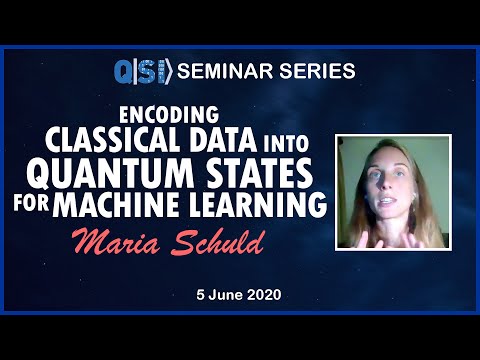
QSI Seminar: Dr Maria Schuld, Xanadu, Encoding Classical Data into Quantum States for ML, 05/06/2020
This talk sheds light on different aspects of encoding classical data into quantum states for machine learning
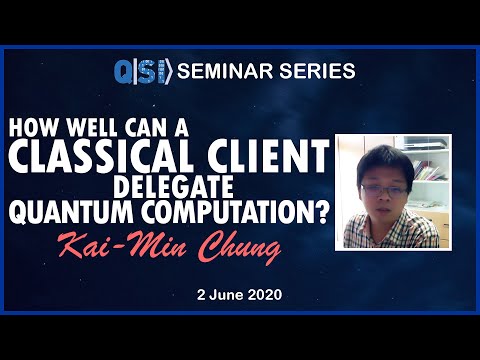
QSI Seminar: Dr Kai-Min Chung, A.Sinica, How well can a classical client delegate quantum comput'n?
Cryptographic protocols for classical clients to verifiably delegate quantum computation to untrusted quantum servers - the desiderata and their feasibility
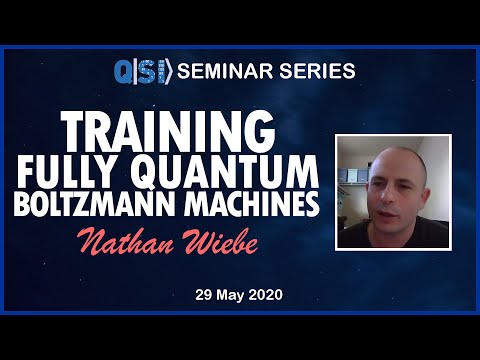
QSI Seminar: Asst Prof Nathan Wiebe, PNNL, Training Fully Quantum Boltzmann Machines, 29/05/2020
A physics inspired class of quantum neural network for generative training TITLE: Training Fully Quantum Boltzmann Machines SPEAKER: Affiliate Assistant Professor Nathan Wiebe AFFILIATION: Pacific Northwest National Laboratory | University of Washington, USA HOSTED BY: Dr Márika Kieferová, UTS Centre for Quantum Software and Information ABSTRACT: In recent years quantum machine learning has grown by leaps and bounds but a major problem still vexes the field is how to efficiently train quantum neural networks
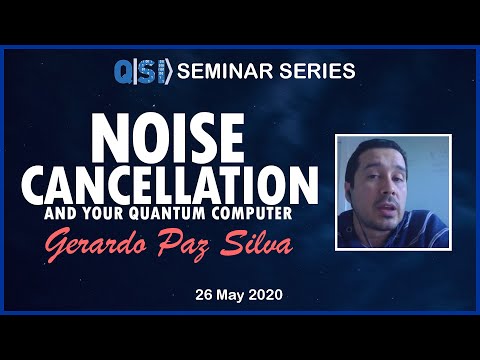
QSI Seminar: Dr Gerardo Paz Silva, Griffith U, Noise Cancellation and your quantum computer 27/05/20
Controls and frames: A new approach to quantum noise spectroscopy TITLE: Noise Cancellation and your Quantum Computer SPEAKER: Dr Gerardo Paz Silva AFFILIATION: Centre for Quantum Dynamics, Griffith University, Brisbane, Qld, Australia HOSTED BY: A/Prof Chris Ferrie, UTS Centre for Quantum Software and Information ABSTRACT: Noise cancellation, as in everyday headphones, requires the ability to characterize & filter out the noise affecting a system one wants to protect
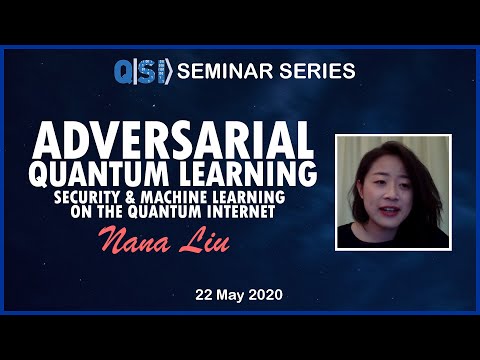
QSI Seminar: Asst. Prof. Nana Liu, SJTU, Introducing Adversarial Quantum Learning, 22/05/2020
Protecting and leveraging quantum machine learning algorithms on a future quantum internet TITLE: Introducing Adversarial Quantum Learning: Security and machine learning on the quantum internet SPEAKER: Assistant Professor Nana Liu AFFILIATION: Shanghai Jiao Tong University, PR China HOSTED BY: A/Prof Chris Ferrie, UTS Centre for Quantum Software and Information ABSTRACT: In the classical world, there is a powerful interplay between security and machine learning deployed in a network, like on the modern internet
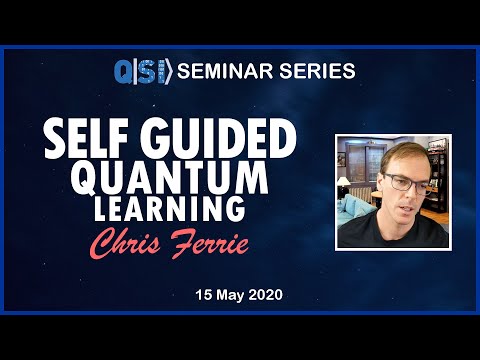
QSI Seminar: A/Prof Chris Ferrie, UTS QSI, Self Guided Quantum Learning, 15/05/2020
Self-Guided Quantum Learning: Estimation via optimisation applied to quantum estimation TITLE: Self-Guided Quantum Learning SPEAKER: Associate Professor Chris Ferrie AFFILIATION: Centre for Quantum Software and Information, University of Technology Sydney, Australia HOSTED BY: Dr Clara Javaherian, UTS Centre for Quantum Software and Information, Australia ABSTRACT: Quantum state learning is often understood as a data analytics problem—large amounts of data collected from many prior repetitions of incompatible measurements need to be churned into a single estimate of a quantum state or channel